
Section: Consumer protection · Last updated: October 27, 2026
This guide is based on the text of the FTC’s Telemarketing Sales Rule, 16 CFR Part 310, sections 310.2, 310.4, 310.6, 310.7 and 310.8, as published in the Electronic Code of Federal Regulations (eCFR) version of October 1, 2026. It is general information, not legal advice.
Putting your number on the National Do Not Call Registry does not stop every call, and telling one company to stop calling works even if you never registered. Both rules come from the same paragraph of the FTC’s Telemarketing Sales Rule. This guide goes through what that paragraph says, who is exempt, and what the rule says about robocalls and calling hours.
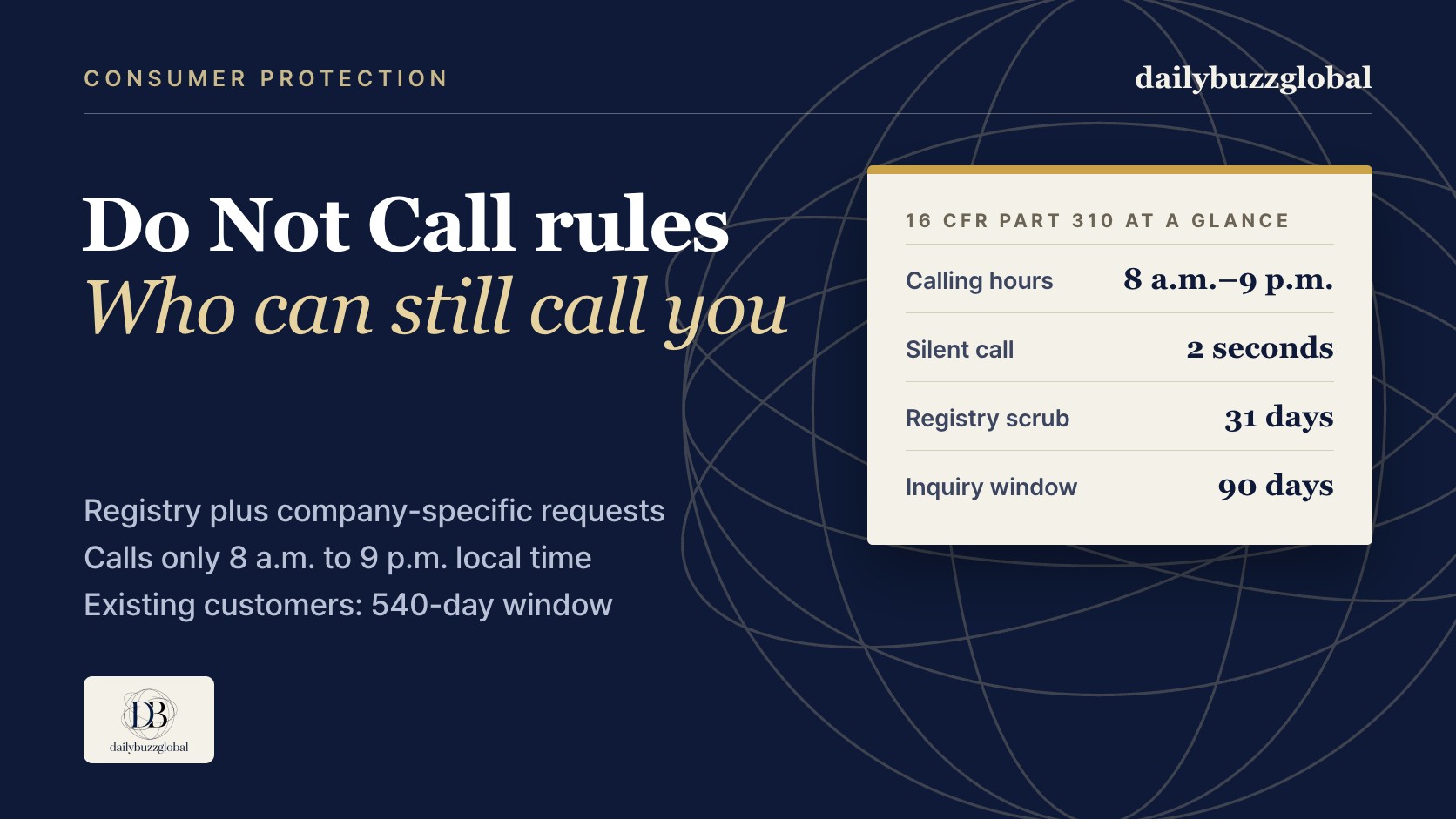
1. The rule at a glance
| Question | What 16 CFR Part 310 says |
|---|---|
| National registry | A seller may not call a number on the FTC’s registry to sell goods or services, unless it has your written agreement or an established business relationship (310.4(b)(1)(iii)(B)) |
| Company-specific request | Once you tell a seller or charity you do not want its calls, it may not call you again (310.4(b)(1)(iii)(A)) |
| Calling hours | Only between 8:00 a.m. and 9:00 p.m., your local time, unless you consented (310.4(c)) |
| Silent calls | A call is “abandoned” if no sales representative comes on within 2 seconds of your greeting (310.4(b)(1)(iv)) |
| Prerecorded sales calls | Need your prior written agreement, and must offer an automated opt-out (310.4(b)(1)(v)) |
| Caller ID | The telemarketer must transmit its number, and its name when the carrier makes that available (310.4(a)(8)) |
2. Two different do-not-call lists
The rule protects you in two ways, and they work differently.
| National registry (B) | Company-specific request (A) | |
|---|---|---|
| How you get on it | Register your number with the FTC | Tell the caller you do not want calls from that seller or charity |
| Which calls it stops | Sales calls from sellers you have no relationship with | Calls made by or for that one seller or charity |
| Existing customers | Seller can still call within the established-relationship window | Your request overrides the relationship |
| Charities | Not covered (310.6(a)) | Covered |
The company-specific request is the stronger tool against a business you already deal with. The registry exception for existing customers ends once you have stated that you do not want that seller’s calls (310.4(b)(1)(iii)(B)(2)).
The rule also lists what a telemarketer may not do when you make that request: hang up on you, make you listen to a sales pitch first, charge a fee, tell you to call a different number, or require you to name the seller the call was made for (310.4(b)(1)(ii)).
3. The two exceptions to the national registry
- Your written agreement. The seller must be able to show you agreed in writing to calls from a specific party. The agreement has to include the number that may be called and your signature; an electronic signature counts where federal or state law recognizes it.
- An established business relationship. Section 310.2 defines it by two time windows, counted back from the date of the call:
| What you did | Window |
|---|---|
| Bought, rented or leased from the seller, or had a financial transaction with it | 540 days |
| Made an inquiry or application about the seller’s product or service | 90 days |
So asking a company for a quote lets it call a registered number for about three months, and a purchase for about a year and a half, unless you tell it to stop.
4. Why calls can continue after you register
The rule gives sellers a safe harbor if they follow written procedures, train staff, and check numbers against a copy of the registry obtained from the FTC no more than 31 days before each call (310.4(b)(3)(iv)). In practice, a newly registered number may not reach every calling list right away. A seller that uses this safe harbor still has to show that a later call was an error, not a failure to get the information it needed (310.4(b)(3)(vi)).
Sellers also pay an annual fee for access to the registry numbers in each area code they call, unless they only call people under the written-agreement or business-relationship exceptions (310.8).
5. Calls the registry does not cover
Section 310.6 lists exemptions. The ones most people run into:
- Charities. Charitable solicitations are not covered by the national registry rule, though the company-specific request still applies.
- Business-to-business calls. Calls to a business to sell it goods or services are exempt from most of the rule, except calls to sell nondurable office or cleaning supplies.
- Calls you start. A call you make that was not prompted by a solicitation is exempt, except for any upsell during it.
- Calls that lead to a meeting. If the sale is not completed and payment is not required until after a face-to-face presentation, most of the rule does not apply, but the do-not-call and calling-hours rules still do.
The rule defines telemarketing as a campaign to induce the purchase of goods or services or a charitable contribution. Calls made for other purposes fall outside that definition.
6. Robocalls and silent calls
A prerecorded sales call is allowed only with your prior written agreement. That agreement must be obtained after a clear disclosure of its purpose, and it cannot be required as a condition of buying anything. When a permitted prerecorded call reaches you, the rule requires:
- A message within 2 seconds of your greeting with the required disclosures.
- If you answer in person, an automated voice or keypress opt-out that adds your number to the seller’s do-not-call list and then disconnects.
- If the call reaches voicemail, a toll-free number that connects to the same kind of automated opt-out.
- Letting an unanswered call ring at least 15 seconds or four rings.
Prerecorded healthcare messages from covered entities under HIPAA are outside this paragraph. For live calls, a seller avoids liability for abandoned calls only if no more than 3% of answered calls in a campaign, or in each 30-day period, are abandoned, and it plays a recorded message with its name and number whenever no representative is available (310.4(b)(4)).
FAQ
Q. I registered last week. Why am I still getting sales calls?
Sellers are expected to scrub against a copy of the registry no older than 31 days. A call shortly after registering may come from a list that has not caught up yet. If calls continue well beyond that, or come from someone you already told to stop, they fall within what the rule prohibits.
Q. My bank keeps calling with offers. Does the registry stop it?
Not if you have had a financial transaction with it in the last 540 days. Tell the caller you do not want calls from that company. After that request, the business-relationship exception no longer covers calls to you.
Q. Can a company sell or share the do-not-call list?
No. Selling, renting, leasing, buying or using these lists for anything other than complying with the rule or preventing calls is itself a violation (310.4(b)(2)).
Q. Is a call at 9:30 p.m. allowed?
Not to your residence without your prior consent. The calling-hours rule is 8:00 a.m. to 9:00 p.m., measured by local time where you are.
Official sources
- 16 CFR 310.2 — Definitions: established business relationship, outbound telephone call (eCFR, October 1, 2026)
- 16 CFR 310.4 — Abusive telemarketing acts or practices, paragraphs (a)(8), (b) and (c) (eCFR, October 1, 2026)
- 16 CFR 310.6 — Exemptions; 310.7 — Actions by states and private persons; 310.8 — Fee for access to the registry (eCFR, October 1, 2026)
- National Do Not Call Registry — donotcall.gov, run by the Federal Trade Commission
This article is general information based on the federal regulation text. A separate federal law, the Telephone Consumer Protection Act, and FCC rules at 47 CFR 64.1200 also cover telemarketing calls and texts, and some states have their own lists; this guide does not cover them. For a specific problem, file a report with the Federal Trade Commission.