
Section: Money & identity · Last updated: October 27, 2026
This guide is based on the text of 15 U.S.C. 1681c-1 (Fair Credit Reporting Act, identity theft prevention; fraud alerts and security freezes) as published by the U.S. Government Publishing Office, including subsections (a), (b), (i) and (j) added or changed by Public Law 115-174 in 2018. It is general information, not legal advice.
A security freeze, often called a credit freeze, stops a credit bureau from handing your credit report to a new lender. Federal law makes it free, sets how fast the bureau has to act, and lets parents freeze a child’s file. This guide goes through the rules as the statute writes them, and compares the freeze with a fraud alert.
1. The rule at a glance
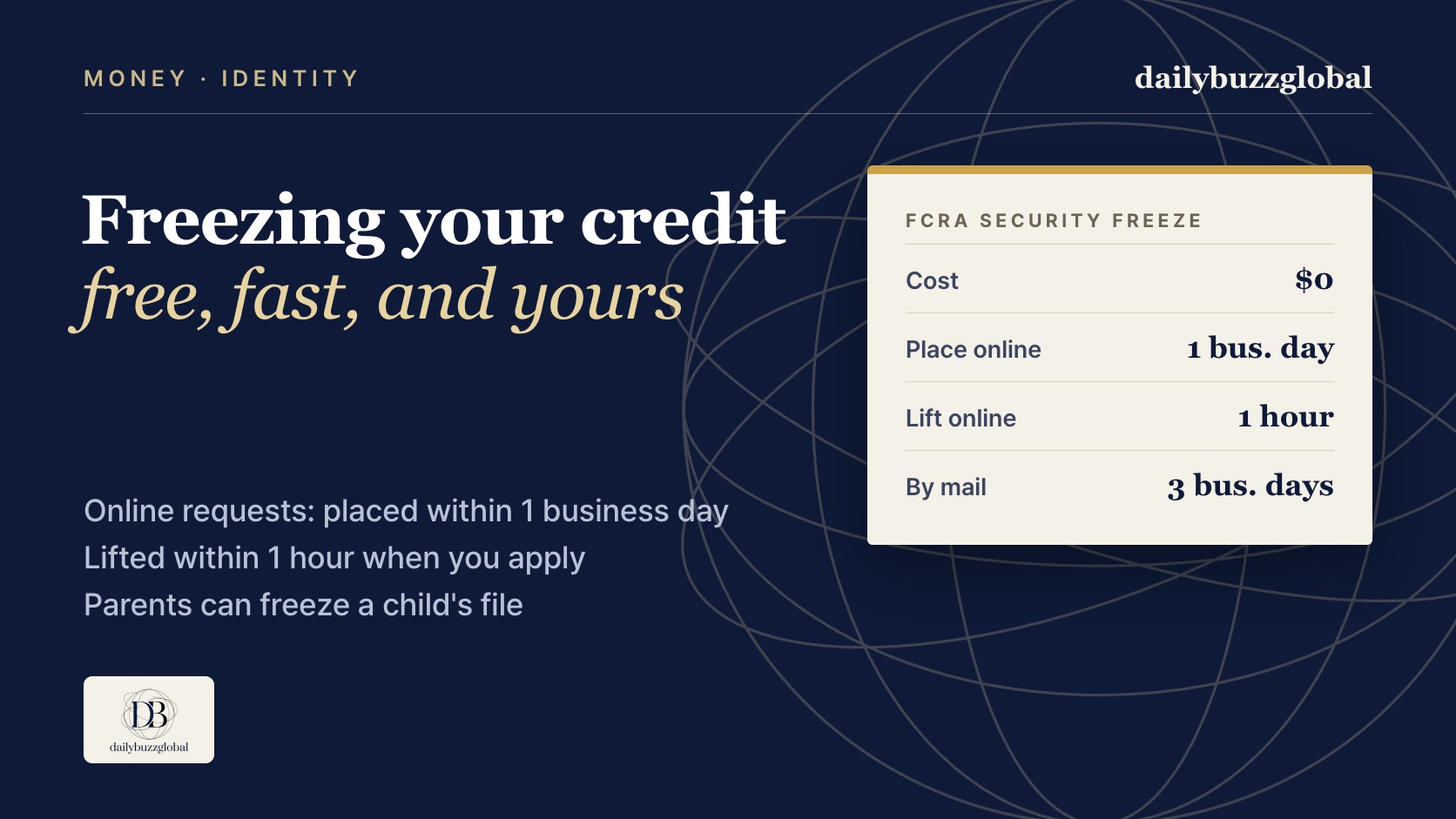
| Question | What 15 U.S.C. 1681c-1(i) says |
|---|---|
| Cost to place | Free of charge |
| Placed by phone or online | No later than 1 business day after the request |
| Placed by mail | No later than 3 business days after the request |
| Confirmation | Within 5 business days of placing it, with instructions for removing it |
| Lifted by phone or online | Free, no later than 1 hour after the request |
| Lifted by mail | Free, no later than 3 business days after the request |
| How long it lasts | Until you ask to remove it; the law sets no end date |
2. What a freeze blocks, and what it does not
The statute defines a security freeze as a restriction that prohibits the bureau from disclosing the contents of your report to anyone who requests it. In practice that means a lender checking your file for a new credit card or loan will not get it. If you do not lift the freeze, the law lets that lender treat your application as incomplete.
Paragraph (i)(4) lists uses that a freeze does not stop. The main ones are:
- Companies you already have an account with, reviewing or collecting that account. The statute says “reviewing the account” includes account maintenance, monitoring, credit line increases and upgrades.
- Government agencies and courts acting under a court order, warrant or subpoena, child support agencies, and agencies investigating fraud or collecting taxes.
- Prescreened offers of credit or insurance under section 1681b(c).
- A credit monitoring service you subscribed to, and requests to give you your own report or score.
- Insurance underwriting.
- Employment, tenant and background screening.
- Identity checks for purposes other than granting credit, and fraud prevention.
So a freeze does not hide your existing accounts, and it is not a tool for keeping a landlord or employer from screening you. Its job is narrower: making it hard for someone else to open new credit in your name.
3. How to place one
- Contact each nationwide bureau. The duty applies to consumer reporting agencies described in section 1681a(p), the nationwide bureaus. In practice those are Equifax, Experian and TransUnion. Unlike the fraud alert rule, the freeze section does not tell one bureau to pass your request on to the others, so plan on making three requests.
- Use the bureau’s webpage, phone line or mail. Each bureau must run a webpage where you can request a freeze, but that webpage cannot be the only way to ask.
- Prove who you are. The bureau acts after it receives “proper identification” from you.
- Keep the confirmation. It must arrive within 5 business days and explain how you will authenticate yourself to remove the freeze later.
The FTC is required to keep a single page at IdentityTheft.gov that links to each bureau’s freeze page.
4. Lifting it for a loan application
When you apply for credit, you can ask the bureau to remove the freeze for a period you choose. A request by toll-free phone or secure electronic means must be honored within 1 hour; a request by mail within 3 business days. Both are free. If you know which bureau a lender uses, lifting only that one is enough for that application, but you will need to ask the lender.
A bureau may remove a freeze on its own only if it was placed because of a material misrepresentation of fact by the consumer, and it must tell you in writing before doing so.
5. Freezing a child’s credit
Subsection (j) covers “protected consumers”: anyone under 16 when the freeze is requested, and incapacitated or protected persons with a court-appointed guardian or conservator. A parent or other representative can request the freeze, free of charge, on the same 1-business-day and 3-business-day timelines.
| What the bureau can ask for | Examples listed in 1681c-1(j)(1) |
|---|---|
| Proof of authority | A court order, a valid power of attorney, a government document showing parentage such as a birth certificate, or a foster care certification from a county welfare or probation department |
| Proof of identification | A Social Security number or card copy, a certified birth certificate, or a driver’s license or other government ID |
If the bureau has no file on the child, it must create a “record” just to hold the freeze, and that record cannot be used to judge the child’s creditworthiness. Once the child turns 16, the child can ask for the freeze to be removed directly.
6. Freeze or fraud alert?
| Security freeze (i) | Initial fraud alert (a) | Extended fraud alert (b) | |
|---|---|---|---|
| Effect | Report is not released to new lenders | Report is released, with a flag telling lenders to verify identity | Same flag, plus stronger verification duties |
| Who can ask | Any consumer | A consumer who suspects in good faith they are or may become a fraud victim | A consumer who submits an identity theft report |
| Length | Until you remove it | At least 1 year | 7 years |
| Other bureaus | Ask each one | The bureau you contact refers it to the others | The bureau you contact refers it to the others |
The two can be used together. The notice the statute requires bureaus to give consumers puts it plainly: a freeze can delay or interfere with the timely approval of a new loan, credit, mortgage or other credit account you apply for. A fraud alert slows a lender down but does not stop the report from being pulled.
FAQ
Q. Does a freeze lower my credit score?
The statute describes a freeze as a restriction on disclosure. It does not change what is in your report; it controls who can see it.
Q. Can a bureau charge me to lift the freeze?
No. Both placing and removing the freeze must be done free of charge under 1681c-1(i).
Q. Can I still check my own credit report?
Yes. Requests to give a consumer a copy of their own report or score are on the list of uses a freeze does not block.
Q. Will a freeze stop my credit card company from raising my limit?
Not necessarily. Existing creditors reviewing your account, including for credit line increases, are outside the freeze.
Official sources
- 15 U.S.C. 1681c-1 — Identity theft prevention; fraud alerts and active duty alerts, subsections (a), (b), (i), (j) (U.S. Code, GovInfo)
- Public Law 115-174, section 301 (2018) — added the free security freeze and protected consumer rules
- IdentityTheft.gov — FTC page linking to each bureau’s freeze request page
This article is general information based on the federal statute text. Some states have their own freeze laws, and each bureau’s request process may differ. For a specific problem, contact the bureau directly or the Consumer Financial Protection Bureau.